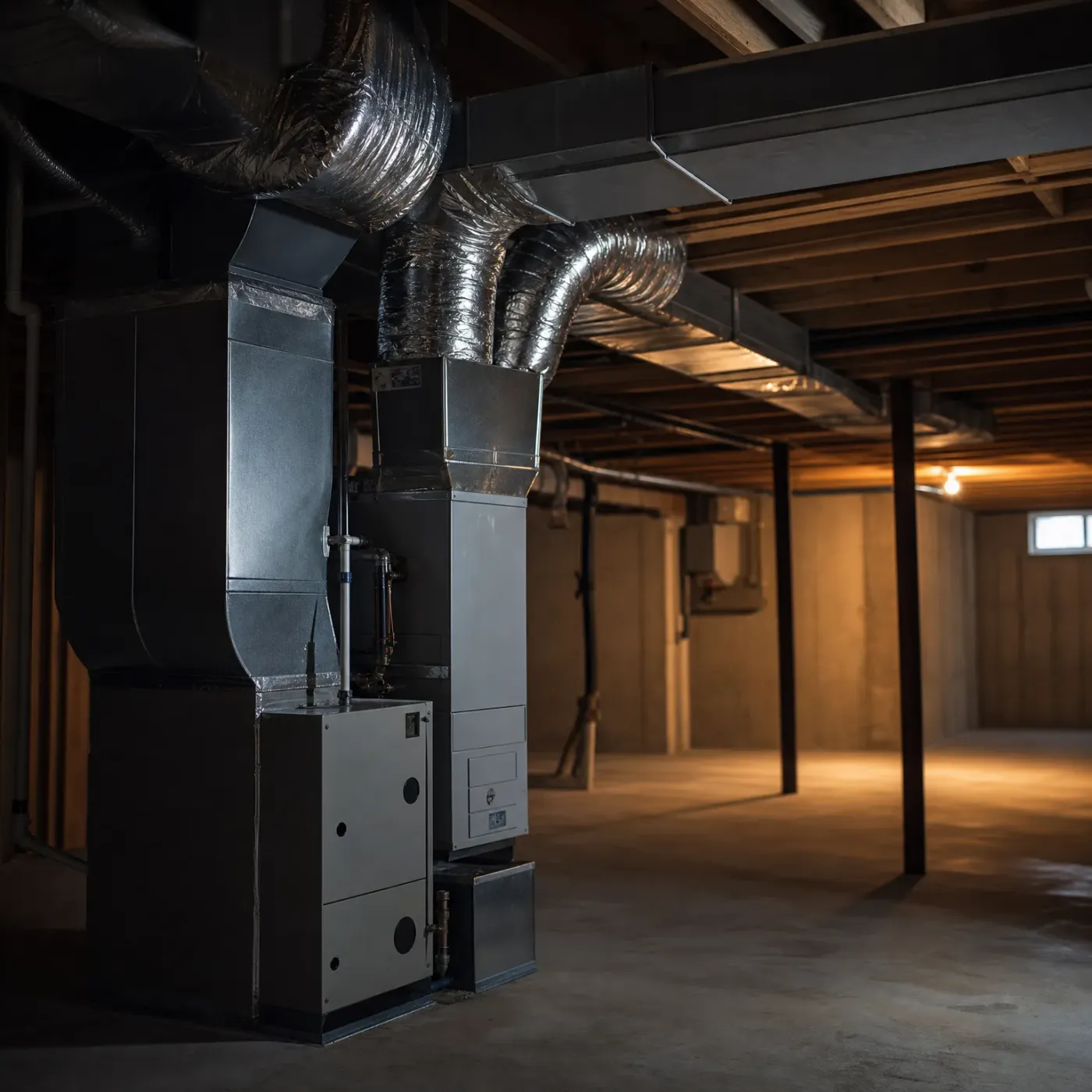








Unfinished basement with concrete floor and walls, exposed wood joists, steel support columns, and two furnace-type units connected to sheet-metal and flexible insulated ducts.

One request and it's handed off

Signs of mold in your air ducts in Colorado

Dry Colorado air doesn't seem like mold weather, but ducts sweat too, especially near a humidifier or a condensate line that isn't draining right. A musty smell when the furnace kicks on, dark spots around the vent covers, or a cough that eases when you leave the house are the signs worth checking. This page walks through what to look for and what it means. Send the form and you're done hunting for who can look at it.

Send my request

A musty smell when the furnace or AC kicks on is usually the first sign, along with dark or speckled spots around the vent covers themselves. Some people notice it less in what they see and more in what they feel: a stuffy nose or cough that clears up when they're away from the house for a day or two. Colorado's dry summers don't invite mold the way a humid climate would, but it still grows wherever moisture gets trapped and doesn't dry out, usually around a humidifier attached to the furnace or a condensate line that's draining slowly or not at all. Once it takes hold inside the ductwork, the system blows spores through every room it serves every time it runs. Dust that looks darker than usual near the supply vents, or that returns heavier within days of cleaning, points the same direction. None of this clears up on its own. The ducts have to be inspected and cleaned, and whatever is keeping them damp has to get fixed too.

Empty basement with bare concrete walls and floor, a steel support column, and galvanized sheet-metal ductwork and pipes running along the exposed wood joist ceiling.
Before you get your ductwork cleaning
Empty unfinished basement with concrete walls and floor, exposed wood joists, metal HVAC ducts and pipes overhead, and a steel support column near a framed wall.
After you get your ductwork cleaning

Colorado's dry air works against mold most of the year, which is why duct mold here almost always traces back to one added source of moisture. A furnace humidifier is a common one. If it drips or sprays more than the air can absorb, the duct right next to it stays wet instead of drying out between furnace cycles. A slow or clogged condensate line near the AC coil does the same thing from a different angle, leaving water sitting in the plenum instead of draining outside. Either way, the moisture lands on dust already sitting inside the duct lining, and that combination is what mold needs to take hold. None of this happens where you can see it. The duct run is behind a wall or above a ceiling, so the first real sign is usually a smell, not a stain. And because the same air moves through the whole house, a damp patch in one duct can show up as a musty smell in a room on the other side of the house.

Where duct mold actually starts

  • Mold needs moisture to grow, so dry Colorado air normally keeps duct systems from supporting it on its own.
  • A humidifier attached to the furnace adds the moisture mold needs, and if it drips or oversprays, the duct nearby can stay damp long enough to grow mold.
  • A condensate line that drains slow or backs up near the AC coil can leave standing water inside the plenum instead of carrying it outside.
  • Mold in that kind of spot stays hidden because the duct run sits behind a wall or above a ceiling, so a smell is often the first clue.
  • Dust sitting on damp duct lining gives mold something to feed on, which is why a musty smell tends to show up near the vents with the most buildup.
  • Spores travel on the same air the furnace or AC pushes through the house, so a problem in one duct run can show up as a smell in a room far from it.
A smiling bearded man in a dark green hooded jacket and blue t-shirt sits on a couch in a living room with shelves, a potted plant, and a bowl of popcorn on a wooden table.
A smiling man in a green long-sleeved shirt sits on a beige sofa in a living room, with a bowl of popcorn in the foreground, a large potted plant and shelving behind him.
A smiling man in a dark blue T-shirt sits on a couch in a dimly lit living room with a bowl of popcorn and a remote on a wooden table, a lit floor lamp and bookshelves behind him, and windows showing greenery.
A smiling bearded man in a dark green long-sleeved shirt sits on a leather couch in a living room, with a bowl of popcorn and a remote control on a wooden table in the foreground.

Done looking for a duct system pro

Skip calling around for someone who cleans ducts.

No charge to send it. You decide if you hire them.

Unfinished basement with concrete floor and walls, exposed wood joists, steel support posts, and large galvanized sheet-metal ductwork running to a furnace or air handler against the far wall.

Dry ducts, normal system

This is what a duct system looks like when it's doing its job. Air moves through clean metal, nothing clings to the inside of the supply runs, and the space around the furnace stays dry. In most Colorado basements, that's the normal state, summer or winter.


Galvanized sheet-metal ductwork and round pipes run along a wooden floor joist ceiling above a bare concrete wall and floor.

Moisture finds a way in

Here the ducts run through the same kind of joist bay, but something upstream, a humidifier pad or a line that isn't draining, is keeping a section damp. That's enough for mold to take hold on the inside of the metal, even with dry air everywhere else in the house.

Power costs 15.69 cents per kilowatt-hour statewide

At 15.69 cents a kilowatt-hour, running a fan harder to push air through moldy ducts costs more than it should. Clean ducts move air the way the system was built to, so the furnace blower isn't working against buildup every time it kicks on.

EIA-861 2025 statewide residential average

A condensate line that backs up can keep a few inches of duct wet for days before anyone notices, and mold only needs about 24 to 48 hours of damp material to start growing.

That's faster than most furnace filters get checked, which is why the first sign is usually a smell, not a stain you can see by looking in the vent.

A woman in a dark gray sweater reclines on a couch with her eyes closed and a knit blanket over her lap, an open book resting face-down in front of her, with a lit table lamp and shelving blurred in the background.
A bearded man in a dark navy sweater over a collared shirt smiles and looks off to the side while seated at a dinner table with a glass of red wine, a lit candle, and a plate of food in the foreground of a dimly lit room.

What the signs are telling you

  • A musty smell at startup and dark spots around the vent covers are the two most reliable signs to check first.
  • A humidifier or condensate line that stays damp longer than a day or two is the most common reason mold gets a start in dry Colorado air.
  • Mold needs only 24 to 48 hours of damp material to take hold, so a drip you haven't noticed yet may already be enough.
  • A furnace blower working harder than it used to can mean buildup inside the ducts, not just a dirty filter.
  • Clean ducts move air the way the system was built to, without the blower fighting its way through.
  • Once you know what's causing it, the next step is finding someone licensed to clean it out and check the source.

The signs point to one thing. Somewhere in the system, something has stayed wet longer than dry Colorado air allows. That's usually a humidifier attached to the furnace or a condensate line that isn't draining the way it should. Everything else, the musty smell at startup, the dark spots around the vent covers, the blower working harder than it used to, follows from that one damp spot. None of it is random, and none of it needs guessing once you know where to look.

What matters now is the timeline. Mold takes hold in a day or two of damp material, which means the smell you noticed this week could trace back to a drip that started well before that. Waiting to see if it clears up on its own just gives it more time. The ducts don't fix themselves, and a stuffy nose that eases when you leave the house isn't something to wait out either.

Finding out takes someone who can get into the ducts, find the source, and clean out what's already grown, not just mask the smell with a new filter. That usually means a licensed contractor who does this work regularly, someone who can tell a damp patch near a humidifier from a bigger problem and knows what Colorado basements tend to get wrong. Rather than spending evenings searching for one, calling around, and explaining the same symptoms to every company that picks up, you can get matched with someone qualified and skip straight to the part where it gets handled.

A modern two-story house with dark siding and stone base at dusk, with lit soffit lights, a path of large rectangular pavers set in dark gravel, planting beds, a lawn, and an orange and blue sunset sky above distant trees and water.

Ductwork Cleaning

It's off your list after this

Duct and vent cleaningDucts or ventsColorado
Step 1 of 2

What ZIP code is the job in?

  • A dimly lit living room corner with a beige upholstered sofa holding a dark green cushion and a chunky knit throw, beside a wooden sideboard with a lit ceramic table lamp, a small potted plant, and a wooden bowl, with a framed artwork on the wall and a mug on a book in the foreground.
    • A local pro who cleans ducts gets in touch with you.
    • Your duct cleaning request goes to a local pro who does this work.
  • A round wooden coffee table holding a round stone vase of green foliage, a lit candle in a glass container, and a small dark bowl, with a beige sofa, cushions and knit throw behind and a window at left.
    • One request and the duct cleaning stops waiting on you.
    • Once you send the form, finding a pro is off your list.
  • Sunlit living room with a wooden coffee table holding a ceramic vase of leafy branches and a carved wooden tray with two stacked books, in front of a beige sofa with tan and green cushions and a potted plant near a window.
    • Fill out one short form instead of calling around.
    • Explain the job once and skip repeating it on every call.
  • Interior corner with a lit ceramic table lamp and wooden bowl on a wood sideboard, a framed picture and branch-filled vase behind, a knit throw over an upholstered chair, and a lit candle in a glass holder, stoneware mug and round planter of green foliage on a wooden table in the foreground.
    • Your duct cleaning request goes to one local pro.
    • Only one pro gets your request, so you hear from one company.





