Colorado HVAC Pros

Musty smell from vents in Lakewood, CO

Get matched with a Jefferson County pro who cleans ducts.

Get my match

That musty smell means moisture is sitting somewhere in your duct system, usually in the evaporator coil or the drain pan under it, growing mold. In Lakewood, it shows up most after the AC has been running during a hot, dry stretch, because the coil gets wet every time it cools the air and dust from the dry summer air gives the mold something to feed on. It can also mean a dirty filter that's blocking airflow and letting moisture linger on the coil longer than it should. A duct cleaning clears out the dust and growth so the air coming through your vents stops carrying that smell. Left alone, it doesn't go away on its own, and mold can spread further into the ductwork the longer the coil stays wet each time the system runs.

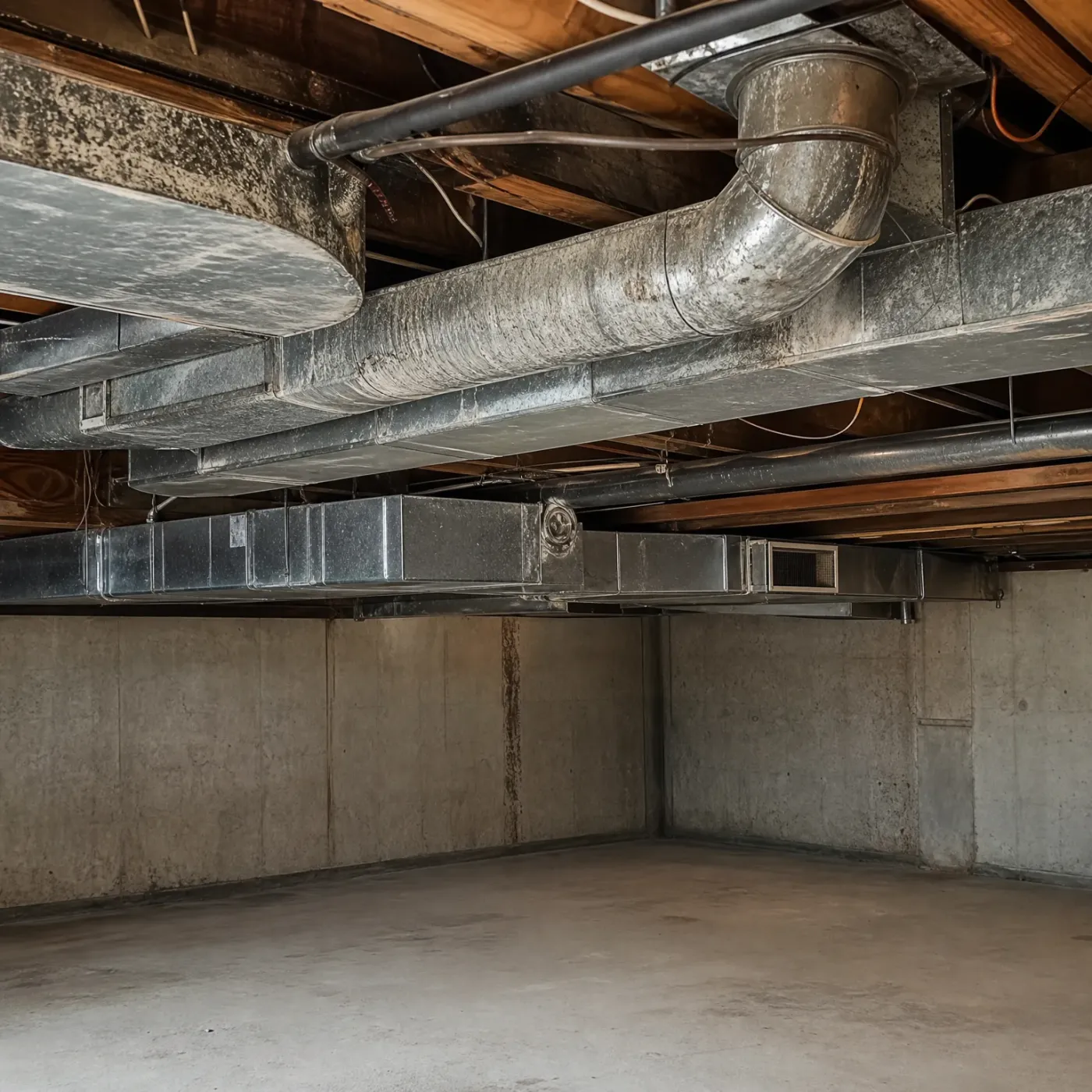
An empty unfinished basement with concrete floor and walls, exposed wood joists, steel beams and support posts, galvanized ductwork and pipes, and a single bare bulb light.

Dry ductwork, no smell

This is what you want under the house. The joists are clean, the ducts are dry, and no musty smell is riding the airflow into your rooms. Moisture isn't sitting anywhere long enough to feed mold, so the air moving through stays just air.

Empty basement with bare concrete walls and floor, with galvanized sheet-metal HVAC ducts, a round duct elbow, and pipes running along the wooden joists of the ceiling.

Moisture and mold on the ducts

Dark staining on the joists and duct surfaces means water has been sitting here a while. Mold growing on the metal gets pulled into the airflow every time the system runs, and that's the smell coming out of your vents. It won't clear up on its own.

Coil Cleaning or Full Duct Cleaning

Coil cleaning

  • Cleaning the evaporator coil clears the mold and the film of dust and moisture that's feeding the smell right now.
  • A contractor can check the drain pan and drain line at the same time, since a slow drain keeps the pan wet between cycles.
  • This addresses what's actually growing in there, so the air coming through the vents stops carrying that smell.
  • It's the right move if the ductwork itself is in decent shape and the smell traces back to the coil or pan.
  • Most homes in Lakewood only need this step, since the dry climate here keeps duct runs themselves from staying damp long.

Full duct cleaning

  • This clears dust, debris and any mold that has spread into the duct runs themselves, not just the coil.
  • It's worth doing if the smell has been going on long enough that you suspect it's beyond the coil and pan.
  • A contractor can inspect the full run while cleaning, catching a disconnected joint or a gap letting in attic or crawlspace air.
  • This takes more time than a coil cleaning alone, since it covers the whole system rather than one component.
  • It makes sense if you've had coil service before and the musty smell came back anyway.
A woman in a cream turtleneck sweater stands beside a multi-pane window looking out at falling snow, with a dimly lit living room containing a lamp, sofa and shelves behind her.
A woman in a beige turtleneck sweater stands by a large window with snow-covered trees outside, in a living room with a lit lamp, sofa with cushions, and a wood stove with visible flames.
A woman with long dark hair in a beige knit turtleneck sweater stands beside a window with snow outside, looking off to the side, with a warmly lit living room containing a sofa, lamps and a coffee table behind her.
A woman with shoulder-length brown hair in a beige knit sweater stands near a window looking outside at falling snow and snow-covered evergreens, with a dimly lit living room, sofa, lamp, bookshelf and framed landscape painting behind her.

Why does this duct smell keep coming back in Lakewood?

  • Half the homes here were built by 1980

    Half of Jefferson County's homes were built in 1980 or earlier, old enough that the ducts have likely never been cleaned.

  • Heat runs September through May

    Heat runs September through May here, so the ducts spend nine months warm and mostly dry before the coil ever gets wet.

  • Cooling runs July through July

    Cooling runs in July alone, a short stretch where the coil turns damp fast and mold gets going before the duct dries out again.

ACS 2020-2024 · NOAA nClimDiv 1991-2020

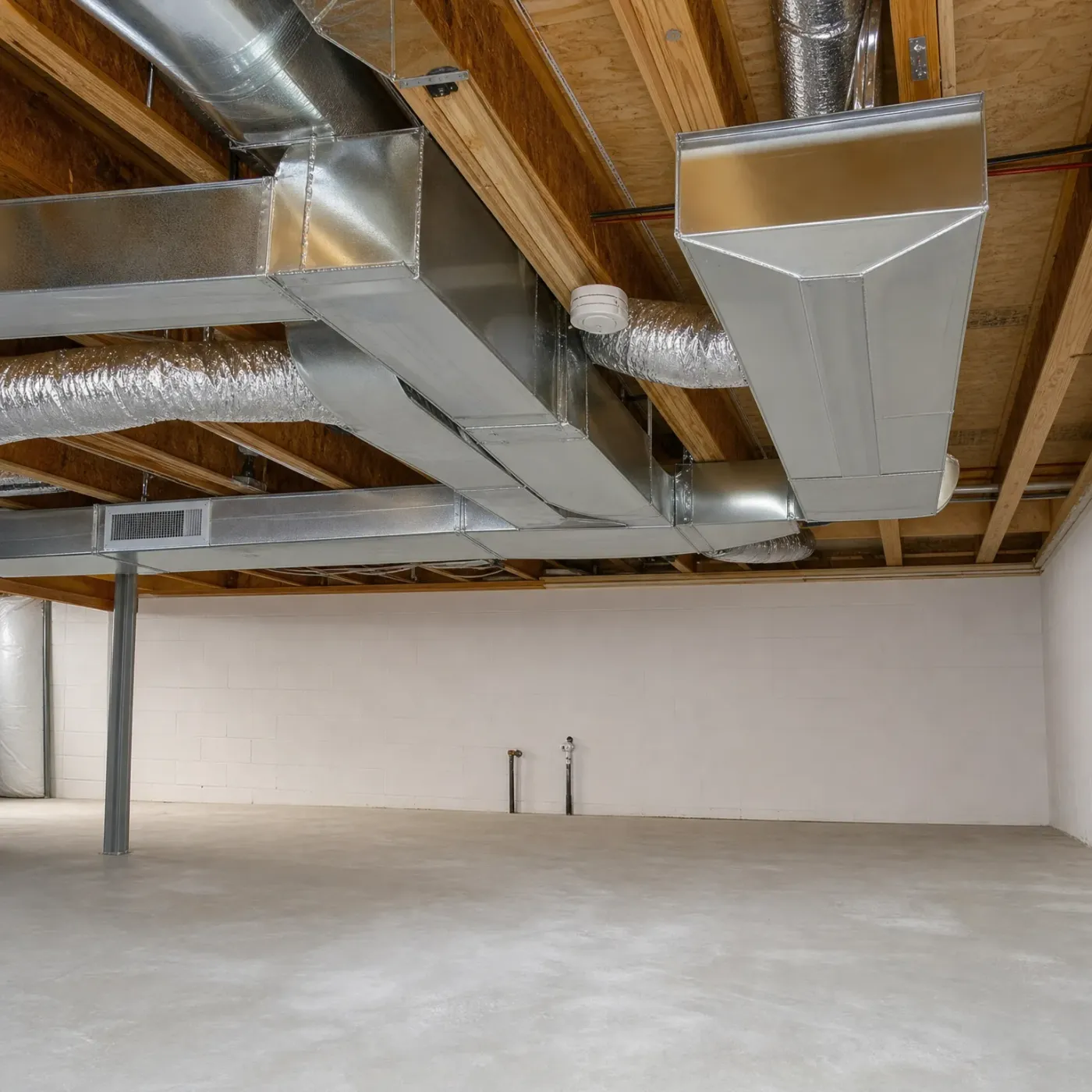
Empty basement with bare concrete floor, painted block walls, and an exposed wood-joist ceiling with sheet-metal and insulated flexible ductwork and a steel support column.

Clean ducts, dry joists

This is what ductwork looks like when nothing's growing in it. The sheet metal trunk and the flex duct running beside it are both free of dust buildup, and the wood joists around them are dry. Air moving through here doesn't pick up a smell.

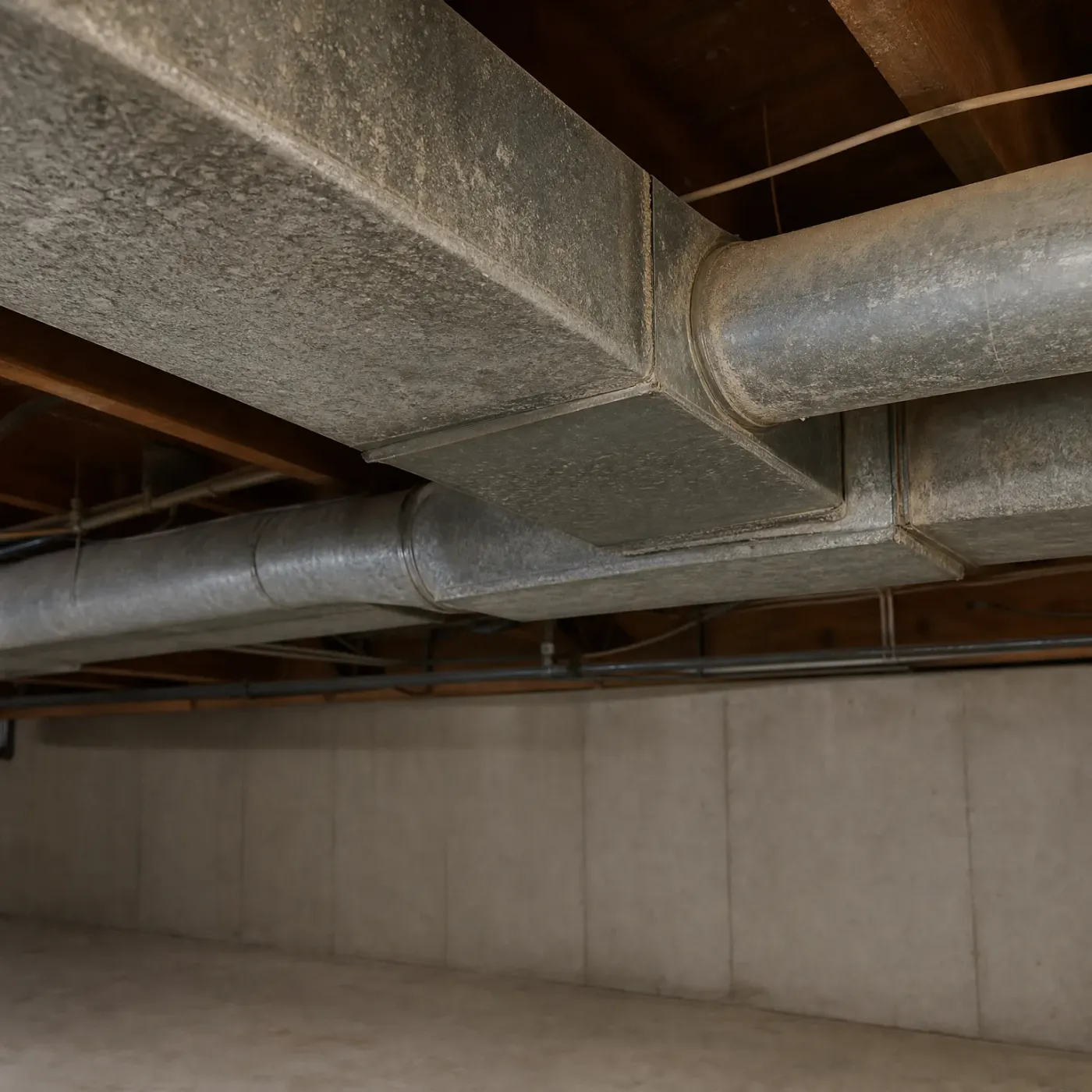
Galvanized rectangular and round sheet-metal ductwork running beneath a wood-joist ceiling in a basement with concrete walls and floor, with pipes and wiring alongside.

Dust and grime on the trunk line

Here the trunk duct and the round branch feeding off it are caked in dust, and that film holds moisture against the metal. It sits against the joists above it too. Air pushed through this duct picks up whatever's growing in that buildup on its way to your rooms.

Empty basement with bare concrete walls and floor, a steel support column, and galvanized sheet-metal ductwork and pipes running along the exposed wood joist ceiling.
Before you get your ductwork cleaning
Empty unfinished basement with concrete walls and floor, exposed wood joists, metal HVAC ducts and pipes overhead, and a steel support column near a framed wall.
After you get your ductwork cleaning

Get matched with a duct system pro in Jefferson County

The pro who gets in touch is licensed in Colorado and works in Jefferson County.

Sending the form costs nothing.

Why the smell keeps coming back

  • Condensation forms on the evaporator coil every time the AC runs, and that water has to drain somewhere.
  • A tilted drain pan or a clogged drain line lets water sit instead of running out, which is where mold usually starts.
  • Mold growing on a wet coil releases spores into the airstream, and the blower pushes them through every duct in the house.
  • The smell is strongest at startup because air sitting in the ducts overnight picks up more of it before it clears.
  • A dirty blower wheel holds moisture and dust against its blades, giving mold another surface to grow on besides the coil.
  • Cleaning the coil and clearing the drain line removes the moisture source, not just the smell it's producing.

The coil in your air handler gets wet every time the AC runs, because that's how it pulls humidity out of the air. Normally that water drips into the drain pan below it and runs out through the drain line. If the pan is tilted wrong or the line is clogged, water sits there instead, and standing water on metal in a dark, enclosed space is exactly what mold needs to take hold. Once mold is growing on the coil, the blower fan is pulling air across it constantly and carrying spores out through the supply ducts into every room on that system. That's why you smell it in the bedroom and the living room both, even though the mold itself is only in one spot near the air handler. The smell is usually worse first thing in the morning or when the system kicks on after sitting idle, because air that's been sitting in the ductwork overnight has had more time to pick up spores before it gets pushed out and diluted. The blower wheel itself can also hold onto moisture and dust on its blades, which gives mold a second place to grow besides the coil. A contractor cleaning the system addresses both: the coil and drain line where the water problem starts, and the blower wheel and ducts where the smell spreads. Clearing the drain line matters as much as cleaning the coil, since a coil that's clean today will grow mold again if water keeps backing up behind it.

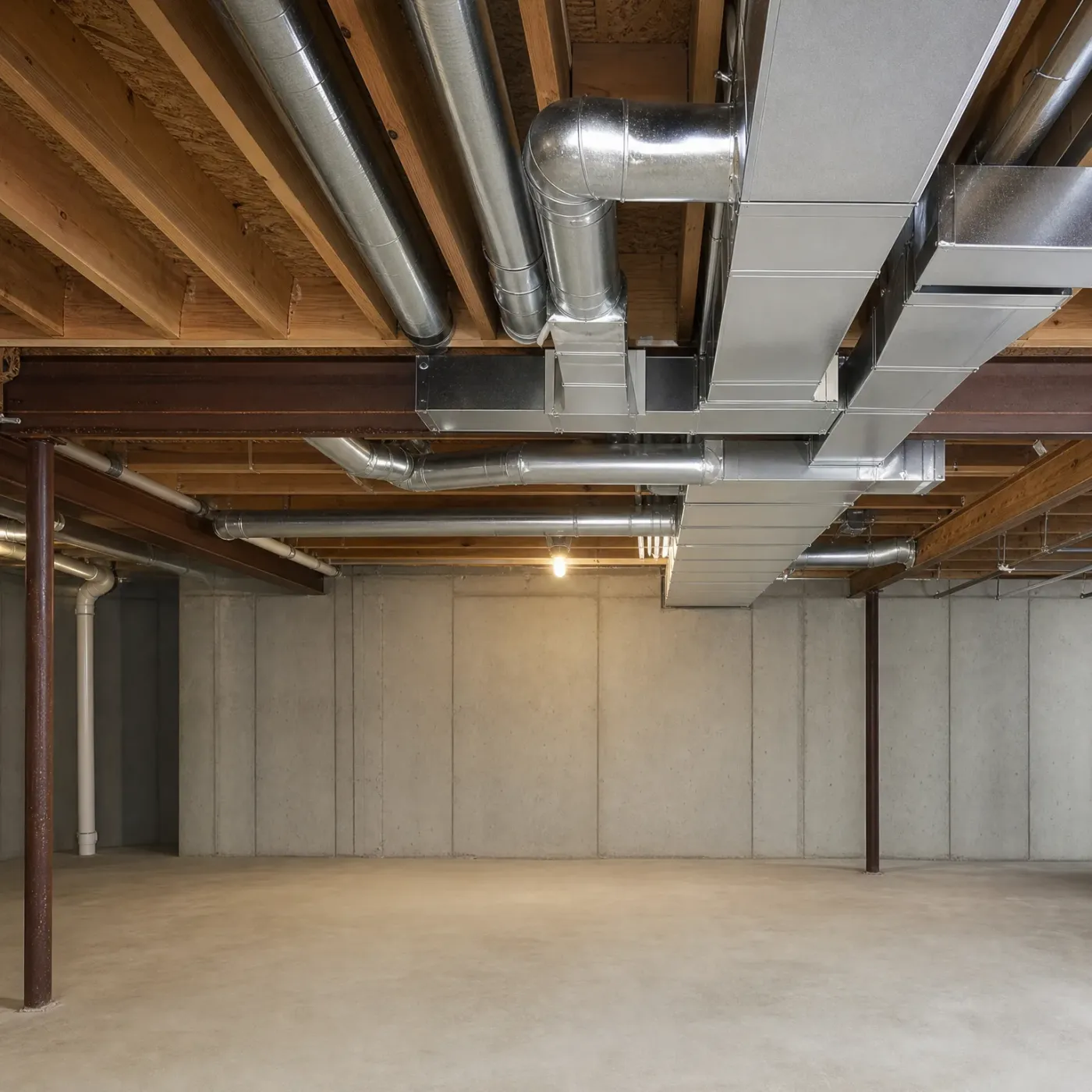
Unfinished basement with concrete floor and walls, exposed wood joists, steel support posts, and large galvanized sheet-metal ductwork running to a furnace or air handler against the far wall.
The ducts run dry and clear, carrying air through the house without picking up anything along the way.
Galvanized sheet-metal ductwork and round pipes run along a wooden floor joist ceiling above a bare concrete wall and floor.
Water sitting in the duct run or the pan below it gives mold what it needs, and the smell rides the air from there.

What is that musty smell coming out of your vents

You notice it most when the AC first kicks on, a damp, closed-up smell that fades after a few minutes then comes back the next time it cycles. Sometimes it's stronger in one room than others, depending on which duct run it's riding. A few homes pick up a sharper, almost sour smell if the drain pan has been sitting wet for a while. None of this is just an odor you can air out by opening a window. It means mold is established somewhere in the system, and every time the blower runs, it's moving mold spores through the house along with the air. Left alone, that's what a household ends up breathing for months at a time, especially with the AC running hard through a dry Lakewood summer.

Dim interior corner of a room with a ceiling air vent, a beige wall, a cream curtain beside a window showing bare trees, and a dark ceramic vase of flowers on a wooden side table behind a light upholstered sofa back.

It's late April, warm enough that you've run the AC a few afternoons this week. You're dusting the living room shelves when you notice it again, that closed-up smell drifting down as the air kicks on. You look up at the ceiling vent and the grille is gray with dust, more than you'd expect for spring. A thin film of it has settled on the bookshelf below and along the top of the picture frames. You run a finger along the louvers and it comes away dark. The couch cushions, the coffee table, all of it's caught a light coating since you last really looked. You make a note to deal with it before summer settles in for good.

Power here costs 15.88 cents per kilowatt-hour

Running the AC to chase that smell out isn't free. At 15.88 cents per kilowatt-hour, a coil caked with mold and dust makes the blower work harder and longer to cool the same rooms, and you pay for every extra minute it runs. A clean coil moves air the way it's supposed to, so the system isn't fighting itself to do the job.

EIA-861 2025

  1. A contractor inspects the coil, drain pan and duct runs for moisture.

  2. Negative air pressure is set up to pull debris through the ducts.

  3. Each duct run is agitated loose and vacuumed section by section.

  4. The evaporator coil and drain pan are cleaned of mold and buildup.

A woman in a cream sweater and jeans stands in an open black front door of a white stucco house, viewed over the shoulder of a man in a navy jacket in the foreground.

A musty smell from your vents means moisture found a place to sit

The smell is real information. It means water is sitting somewhere in your duct system long enough for mold to take hold, usually the evaporator coil or the drain pan underneath it. A contractor can check both along with the drain line and the duct runs, and clean out what's growing there.

You're the kind of homeowner who deals with a problem like this before it turns into something bigger, like mold spreading further into the ductwork or the blower working harder than it should. Once you request a cleaning, you're matched with one licensed contractor who serves Lakewood and knows what a Jefferson County coil looks like after a dry, hot stretch of weather. That contractor reaches out to you directly, so you're working with one company, not fielding calls from several.

A light gray sofa with gray and beige textured throw pillows and a cream knit blanket beside a white-framed window, with a small round side table holding a ceramic vase and potted greenery.
A bearded man in a plaid flannel shirt stands indoors looking out a condensation-covered window at a snowy landscape, with a speckled mug on the sill and kitchen shelves behind him.
A bearded man in a dark blue T-shirt sits on a gray couch, smiling and looking down to his left, with a bookshelf and a bright window behind him.

Ductwork Cleaning

Find a duct system cleaning pro in Jefferson County

A licensed pro who works in Jefferson County gets your request.

A black-framed smartphone standing upright against a plain light gray background, its screen filled with solid green.
Duct and vent cleaningDucts or ventsJefferson County, CO
Step 1 of 2

What ZIP code is the job in?