Mini Split Installation in Gypsum, CO
Tell us about the house, and a licensed contractor who covers Eagle County will get in touch.
Tell us about the job
It takes about a minute.
Step 1 of 3: Equipment
In Gypsum, a mini-split works nearly the whole year
Heat is what a mini-split in Gypsum is really there for. Homes here need it from August through June, and winter nights average 11°F from December through February. The heat pump has to keep pulling warmth out of air that cold for eleven months of the year, not just run a furnace backup on the coldest nights.
A new mini-split manufactured now has to meet 7.5 HSPF2 for heating and 14.3 SEER2 for cooling under the federal minimum. With summer afternoons averaging only 73°F, the cooling side of that rating will rarely be tested here. The heating side is what matters, night after night, most of the year.
- 11 months
- August through June, your system heats
- 11°F
- the average winter night it heats against
- 73°F
- the average summer afternoon it cools against
- Is a mini split worth it?
- For most homes in Gypsum, yes. Winters here run long, with heat needed from August through June and winter nights averaging 11 degrees, so a mini split has to earn its keep mostly as a heater rather than an air conditioner. Look for a cold-climate model, since a unit not built for low temperatures can lose capacity on the coldest nights. Whether it makes sense for your house depends on what you're heating with now, and a contractor can walk through that with you.
- How many rooms can a mini split cover?
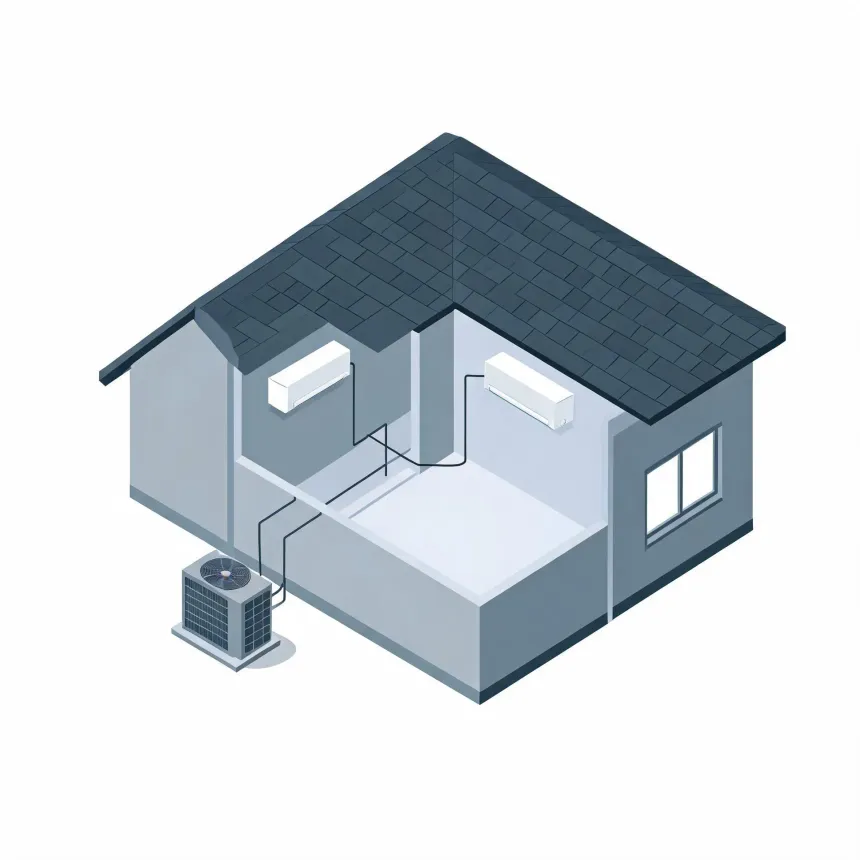
- A single outdoor unit can run more than one indoor head, so it can cover more than one room. A single-zone system heats or cools one room well. A multi-zone system splits the outdoor unit's capacity across several indoor heads, so each room gets a share of the total output rather than its own full-size unit. How many zones your house needs depends on the square footage and layout of each room, which a contractor works out during an in-home visit.
- Can a mini split heat a whole house?
- It can, if it's sized and placed for that. A multi-zone system with a head in each main room, or several single-zone systems working together, can carry the whole heating load. Since homes here need heat from August through June with winter nights averaging 11 degrees, the system has to be sized for that low point, not just for a mild day. Whole-house coverage depends on the layout, how open the rooms are to each other, and how much heat the house loses, so a contractor needs to look at your home before sizing it out.